
Imagine you are going to a genteel scone and crumpets breakfast party in the English countryside. In another time and place, to be invited to such a gathering would have meant you had arrived, as they say, into the society pages. "Anything less would be uncivilized," you might utter, with your pinky finger sticking way out in the air, as you and your gentle friends titter over tea and biscuits and contemplate a jaunt to the opera. You are uninvited, but you still want to go, so you invite yourself to the gathering, knowing there are others like you in support of a planned assembly, a rally of sorts, even a demonstration of your numbers, and your attendance is part of a larger uprising and community movement. Before, during and after the event, you post and look at pictures and video, text, tweet, maybe facebook or google search, chat, email, all this in support of your common goal, to non-violently disrupt business-as-usual, and pleasure-as-usual, in the layers of society that seem to you unbearably hardened, even calcified. In preparation for the protest, you and your ever growing society hang out and chat in-person, then use your laptop and notebook computers, tablets, cellular phones, smart phones and PDAs, to form your own network of friends, to create a buzz and attract more people, and on the day of the event, you print out maps and directions, see what other people are doing and tag along, and before you know it, you've used the Internet and mobile phone network (collectively called the cloud) to plan, collaborate, share, publicize, attend, rally, demonstrate, and afterwards, document what happened, learn from others, and possibly prepare to organize and make the announcement to occupy another location.
About a year and a half ago, the author Clay Shirky gave a talk on cognitive surplus, "the shared, online work we do with our spare brain cycles. While we're busy editing Wikipedia, and making LOLcats," he argues, "we're building a better, more cooperative world." Clay states that people want to consume, but also we like to create, and sometimes we want to share. He relates the story of a woman in Kenya who found, in the midst of a disputed presidential election, that there was an outbreak of ethnic violence. In her blog, she solicited from her commenters more information about the dangers inherent in any succession of power in human society, and what areas to be mindful of, depending on who you were. She collated and posted the information flowing in, but there was so much data coming in, it became way more than one woman could manage. She asked if there was a way to automate the process. Two programmers saw her plea for help and, in 72 hours, launched ushahidi, which means witness or testimony in Swahili. This application very simply takes reports from the field, i.e., from the web, or mobile phones and sms, aggregates those reports, puts it on a map and makes it public. The app spawned a social push which became known as crisis mapping. Enough people found ushahidi valuable that the programmers decided to make it open source and turn it into a platform. The number of deployments of ushahidi went from a single idea and implementation in Kenya, to global reach, in less than 3 years. Cognitive surplus, then, can be the ability of the world population to volunteer, contribute, and collaborate on large, sometimes worldwide, projects.
In his talk (below), Clay Shirky states that civic value is when something is created by the participants, but enjoyed by society as a whole; when something is enjoyed just by the participants, that would have only communal value. When the Occupy Wall Street movement was getting started in New York, one of the first things the group did was put, at the top of their website, a link to the software platform that the participants used to consume, create and share. The idea was, should the movement catch fire (and how!), Occupy groups in other cities could download, install, deploy and begin their own geographic base of online operations. Github is where the occupy movement and ushahidi store their repositories, which contain the master copy of the project. Anyone in the world, on their own initiative, can download and install the software built from the master code, On a computer with a connection to the internet, you can soon host your own city chapter. You can contribute to the technological platform you downloaded by helping people get connected and stay more involved towards a common goal. For those who have spent enough time thinking about and using a tool, suggestions for improvement or features come to mind, such as adding the ability to show live video, or to display content in a specific language, or to give some users more or less responsibilities and privileges. If you make a change to your local copy, such as fixing a mistake, those improvements can be merged into the master code, and the communal becomes civic.
But that is all really big picture, so let's bring it back to the day to day life each one of us leads. How does this all apply to me? As we start in on 2012, what gets me out of bed in the morning is getting more users. I am here, and at your service. Last year, I had a goal of creating 2 blog posts for every month, which worked out well; now my new year's resolution is to make an app and host it on github, and to show you how to do it.
With the Tea Party, Occupy, the Arab Spring, and the demonstrations led by a Russian blogger Alexei Navalny against Vladimir Putin in Russia, it seems protest is in season.Here's the link to the page with the video:
http://www.ted.com/talks/clay_shirky_how_cognitive_surplus_will_change_the_world.html
Hat tip to JJ Behrens for sharing the video.
Monday, January 30, 2012
Thursday, December 29, 2011
The Danger in Selling Digital Goods on Ebay & Accepting Paypal as Payment
Many of you casual gamers on Facebook may know how popular digital goods are in the online marketplace, where people pay lots of real money to buy items used in video games and online transactions. Digital goods can range from cell phone ringtones, music, movies and shows, electronic books (ebooks), rights to domain names, online accessories and characters (avatars) in video games, electronic gift certificates and coupon codes, online electronic currencies like Linden dollars and bitcoins (btc), financial & cash services like ukash, moneypak, pecunix and more, secure, encrypted web browsing and software packages, sometimes written to a flash drive that you can use to boot from, and I'm sure there is much that I missed and am not aware of. I'm not going to identify what I sold, because it's embarrassing that I not only got scammed, but that I spend so much time online acquiring digital goods. Maybe it's because my fear is I am socially inept in crowds and I would rather be indoors playing video games than out mingling and meeting people. Suffice it to say that, yesterday, around this time, I felt richer. 24 hours later, I feel poorer. Here's the story:
I poured quite a bit of time and effort into acquiring an online digital good. At the same time, I decided to take advantage of a temporary promotion on ebay where you can list items for free for the next 3 days. Among the many items that I listed, I decided to take a chance and list that particular digital good, my asking price for it about 25% higher than what I paid for it, after ebay and paypal fees. I had done my due diligence, looked at competitors, saw many people buying and selling the same item on ebay, and thought, with my account in good standing and lots of positive feedback, why not see if it might sell? Well, imagine my pleasant surprise when I got out of bed in the morning, checked my email, and saw that my item had sold through Buy It Now for a couple of thousand dollars, hand to God. The buyer also seemed good, with 76 feedback and a rating of 95.4%, and he paid me with paypal, in the amount of $2736 after ebay and paypal fees. The buyer used ebay messages to specify the online address where I could deliver the item, and after confirming the money was in my paypal account, I promptly sent the item to him.
I was feeling high for about most of the day, happy that all the money, time and effort I had spent in my online community was beginning to pay off. The ebay buyer had told me the item had been received, and had even given me positive feedback. Imagine my surprise and horror when, around 10 pm yesternight, about 11 hours after I delivered the digital good, I received 2 messages, one from ebay, one from paypal, with the Subjects: "MC143 eBay Listing Removed", and "Notification of Cancelled Withdrawal", respectively. The first message said:
I poured quite a bit of time and effort into acquiring an online digital good. At the same time, I decided to take advantage of a temporary promotion on ebay where you can list items for free for the next 3 days. Among the many items that I listed, I decided to take a chance and list that particular digital good, my asking price for it about 25% higher than what I paid for it, after ebay and paypal fees. I had done my due diligence, looked at competitors, saw many people buying and selling the same item on ebay, and thought, with my account in good standing and lots of positive feedback, why not see if it might sell? Well, imagine my pleasant surprise when I got out of bed in the morning, checked my email, and saw that my item had sold through Buy It Now for a couple of thousand dollars, hand to God. The buyer also seemed good, with 76 feedback and a rating of 95.4%, and he paid me with paypal, in the amount of $2736 after ebay and paypal fees. The buyer used ebay messages to specify the online address where I could deliver the item, and after confirming the money was in my paypal account, I promptly sent the item to him.
I was feeling high for about most of the day, happy that all the money, time and effort I had spent in my online community was beginning to pay off. The ebay buyer had told me the item had been received, and had even given me positive feedback. Imagine my surprise and horror when, around 10 pm yesternight, about 11 hours after I delivered the digital good, I received 2 messages, one from ebay, one from paypal, with the Subjects: "MC143 eBay Listing Removed", and "Notification of Cancelled Withdrawal", respectively. The first message said:
We recently learned that someone was using an account to bid on items without the account owner's permission. For this reason, we have canceled all bids on the following listing...All associated fees have been credited to your account. Please note that we're working with the account owner to prevent any additional unauthorized activity.The second message, from Paypal, came about because I was trying to transfer the money sent by the buyer for my digital good into my bank account, and it read:
If you have any concerns or questions, click "Customer Support" at the top of most eBay pages.
We're sorry for any inconvenience, and we thank you for your patience and cooperation.
Sincerely,
eBay Customer Support
Recently, your account balance became negative. To cover your negative balance, we have reversed "Pending" electronic funds transactions that you had initiated from your PayPal account. This is to confirm that the following transaction(s) have been cancelled...Thanks,Long story short, I called ebay, told them the buyer was making a false claim, because I had been in touch with the buyer by the hotmail email address associated with the buyer's Paypal account, and also by ebay messages, and I had an email from the buyer saying the digital good had been received, and the buyer had even given me positive feedback. My protests had no effect. In the eyes of the ebay customer service agent, Dustin, the account that bid on and won my item was accessed by a third party, without the account holder's permission, and for security reasons, Dustin could not tell me what the criteria or proof was that ebay possessed showing them the account had been accessed by a third party. When I told Dustin that the problem was I had lost the item I sent to the buyer, Dustin put me on hold, then said he was going to advise me to contact law enforcement about this. When I told Dustin that the buyer was in a different country, Dustin said "that's the only way we can resolve it." When I asked for the payment back, Dustin said they could not do that, because the items were purchased by a third party. At this point Dustin must have heard me typing, because he asked me if I was recording this call, and when I said yes, Dustin said at this point he is forced to disconnect this call. Click. And that, ladies and gentlemen, is the embarrassing story of how I got scammed out of the digital good I had, and the money I paid for it.November 7, 2013: Latest update on this case is here.
PayPal Finance Department
Tuesday, December 27, 2011
Actual Telephone Numbers Made Famous by Artists in Popular Music
As someone who has lived in rental units as a tenant since leaving home at age 19, numerous times I've had to move to a new area and relinquish an old phone number. In picking a new one, I've always put some time, thought and care into it, wanting my new phone number to be easy for me to remember when giving out to people, and difficult for people to misdial. One thing that has always amazed me is how contemporary artists will include what I believe to be their actual telephone number in their music. Google Answers has a subject, "famous telephone numbers in songs", that shows people have been singing about phone numbers since the 1960s, back when the format was, to place a call, you had to dial a live operator, say a place name first, then say a five-digit number, before being connected by the operator. Now that we are in the age of seven digits (or age of ten digits if you include area code), one of the more famous phone numbers may be 867-5309, and hearkens back to the early 1980s, for which there is an entire Wikipedia page devoted to it.
If you ever are in the position to pick a new phone number, you might wish to steer clear of these, or contrarily, you may try to seek out these phone numbers, as they are easier to remember when set to a catchy tune (but be sure to expect multiple people trying to call you asking for somebody other than you):
Tony! Toni! Toné! - Whatever (1991): "Whatever you want, girl you know I can provide. Whatever you need, call 632 2135"
Alicia Keys - Diary (2004): "Oooh baby if there's anything that you fear, call 489 4608 and I'll be here"
Mike Jones - Back Then (2005): "281 330 8004, hit Mike Jones up on the low, cause Mike Jones about to blow"
Scientists have conjectured that the reason why every human culture that has been studied has music, why music appreciation is innate in almost all of us, is because the early man that was musical was more in tune with other early humans and more willing to cooperate with those that could appreciate music; musical human societies were more cohesive and likely to stick together than societies made of non-musical humans. Even if you don't accept that premise, music can be seen as a kind of social glue that binds us all together. The person who devotes him or her self to making new forms of music, if s/he is lucky, can step into the role of entertainer, and as an added benefit, when performing, that performance and song can serve as a sort of mating call, if you will, demonstrating to the audience his or her social and sexual value. The next time you feel lonely, pining for a mate, you could do a lot worse than create something, be it music, art, technology or science, that includes, or is based on, your actual telephone number.
If you ever are in the position to pick a new phone number, you might wish to steer clear of these, or contrarily, you may try to seek out these phone numbers, as they are easier to remember when set to a catchy tune (but be sure to expect multiple people trying to call you asking for somebody other than you):
Tony! Toni! Toné! - Whatever (1991): "Whatever you want, girl you know I can provide. Whatever you need, call 632 2135"
Alicia Keys - Diary (2004): "Oooh baby if there's anything that you fear, call 489 4608 and I'll be here"
Mike Jones - Back Then (2005): "281 330 8004, hit Mike Jones up on the low, cause Mike Jones about to blow"
Scientists have conjectured that the reason why every human culture that has been studied has music, why music appreciation is innate in almost all of us, is because the early man that was musical was more in tune with other early humans and more willing to cooperate with those that could appreciate music; musical human societies were more cohesive and likely to stick together than societies made of non-musical humans. Even if you don't accept that premise, music can be seen as a kind of social glue that binds us all together. The person who devotes him or her self to making new forms of music, if s/he is lucky, can step into the role of entertainer, and as an added benefit, when performing, that performance and song can serve as a sort of mating call, if you will, demonstrating to the audience his or her social and sexual value. The next time you feel lonely, pining for a mate, you could do a lot worse than create something, be it music, art, technology or science, that includes, or is based on, your actual telephone number.
Tuesday, November 29, 2011
New Study Shows No Link Between Road Traffic Collisions & Daylight Saving Time
People who follow the news know that every year, around this time, there seem to be an increase in trusted information sources warning us about bicycles and pedestrians colliding with cars, and the correlation with Daylight Savings Time. Some of these vehicle collisions are fatal, and we remember when someone dies. Invariably the reports quote police officers and traffic safety officials attributing said automobile collisions to the twice-a-year annual changing of the clocks, the explanation being that either the onset of darkness is sooner and people are in a rush to get home, or there's not enough light early in the morning when people are in a rush to get to work, or people have to wake up earlier than they are used to, and this disruption in the body's Circadian rhythm means people are less aware at the wheel. In many cases, you add on the idea that some motorists have problems adjusting their eyes to the new light level, or the sun may be in their eyes, or it's too dark, and one can readily see why accidents might abound around the changing of the clock. The idea then that there is a correlation between Daylight Saving Time and an increased rate of accidents sounds plausible, even somewhat convincing. But what if there is no increase in traffic accidents around Daylight Savings Time? In order to avoid confirmation bias (the notion that "people see what they want to see", in that it is a particular human weakness that we all remember the purported evidence that supports an idea we want to believe, and we discard any suspect evidence that threatens that belief), one should approach an answer to this question using the power of science.
In the past, there've been studies to support this claim. However, the latest study, culled from Wikipedia, seems to show, at the very least, the jury is still out, and that there may even be no connection:
Daylight saving time transitions and road traffic accidents.
Lahti T, Nysten E, Haukka J, Sulander P, Partonen T.
http://www.ncbi.nlm.nih.gov/pubmed/20652036
In the past, there've been studies to support this claim. However, the latest study, culled from Wikipedia, seems to show, at the very least, the jury is still out, and that there may even be no connection:
According to earlier studies, this change in time-schedule leads to sleep disruption and fragmentation of the circadian rhythm. Since sleep deprivation decreases motivation, attention, and alertness, transitions into and out of daylight saving time may increase the amount of accidents during the following days after the transition. We studied the amount of road traffic accidents one week before and one week after transitions into and out of daylight saving time during years from 1981 to 2006. Our results demonstrated that transitions into and out of daylight saving time did not increase the number of traffic road accidents.2010 Jun 27.
Daylight saving time transitions and road traffic accidents.
Lahti T, Nysten E, Haukka J, Sulander P, Partonen T.
http://www.ncbi.nlm.nih.gov/pubmed/20652036
Saturday, November 26, 2011
How to Sue a Corporation in Small Claims Court
Several years back, I sued AT&T in small claims court, and the judge ruled in my favor for $1000. My complaint was that AT&T (back then they were doing business as Pacific Bell) had never notified me, as a DSL subscriber, that I could have availed myself of a number of features of their DSL package, including a nationwide network of local dialup phone numbers, and free web hosting and 3 email addresses. I was never given notice of these parts of their package, and felt that I very much could have used those services if only I had known. I had subscribed to DSL for 2 years by the time I found out, and believed I was due some sort of credit for the services the company had failed to notify me of, and I had never used. I called the company, detailing my complaint, and asked for free DSL for a year (back then AT&T was the only game in town in terms of providing DSL service in my area). The representative I spoke to declined to give me free DSL, but offered me a discounted rate per month. Hard-head that I was back then, I decided to reject their counter-offer, and began to prepare my case. It was a lot of work, and after I had served the corporation with the suit, I even got a call from another representative, offering me 3 free months of DSL service; I decided to reject that offer and proceed with my lawsuit. In court, no one showed up to contest the charges (a corporation usually must pay a lawyer much more than a potential liability of $10,000 to represent the company in a small claims case), but that doesn't mean you automatically win. In my case, the judge wanted to hear the basis for my lawsuit, and I argued that, at the time I discovered I was due the extras that I was never notified of, given Pacific Bell's monopoly on DSL service, I couldn't have simply moved my business elsewhere if I was dissatisfied with their customer service. The phone companies that owned the infrastructure were only just beginning to lease their lines to competitors at the time I argued my case, but the judge agreed with my logic and ruled in my favor.
Flash forward to the present: last year, I was operating my motor vehicle, a Honda Accord, and discovered that the seatbelt alarm for my car was starting to flash and emit a continuous beep, even though I made sure I had my seatbelt properly secured. Now, it's important to clarify that, by seatbelt alarm, what I'm talking about is actually a warning system that has a flashing light and audible alarm, indicating my seatbelt is not secure during operation of the vehicle (hence seatbelt alarm). I told my local mechanic about the problem, and he suggested I take the car into the dealership, as what I was describing seemed to indicate a problem with the seatbelt system, and since Honda has a lifetime warranty on seatbelts, I could get the problem repaired for free. I did as my mechanic suggested, but then I got a call from the dealership repair shop that the problem I had would not be covered under warranty, as their mechanic had deemed the problem to be an electrical issue, and not a seatbelt issue, so Honda would not pay for the cost of repair. As explained to me by the dealership mechanic Chuck, for my particular model of vehicle, the seat belt system is one of the most complicated ever made. To fix the problem, which is probably a wire that is shaved or touching the body of the car somewhere, the mechanics would have to take the panels off, including the dash panels and door panels, and trace the wiring from the sensors to everything that's involved with the system to find out where a wire is touching the body of the car somewhere. So even though Honda says in their warranty booklet that "a seat belt that fails to function properly is covered for the life of the vehicle," I am apparently out of luck.
I believe Honda is being disingenuous. If the problem is electrical, it's still manifest by the seat belt alarm beeping and flashing for no apparent reason, and it was a mechanic who first suggested that the problem might fall under Honda's limited lifetime warranty for seat belts. That's why I plan to sue them. Stay tuned.
Flash forward to the present: last year, I was operating my motor vehicle, a Honda Accord, and discovered that the seatbelt alarm for my car was starting to flash and emit a continuous beep, even though I made sure I had my seatbelt properly secured. Now, it's important to clarify that, by seatbelt alarm, what I'm talking about is actually a warning system that has a flashing light and audible alarm, indicating my seatbelt is not secure during operation of the vehicle (hence seatbelt alarm). I told my local mechanic about the problem, and he suggested I take the car into the dealership, as what I was describing seemed to indicate a problem with the seatbelt system, and since Honda has a lifetime warranty on seatbelts, I could get the problem repaired for free. I did as my mechanic suggested, but then I got a call from the dealership repair shop that the problem I had would not be covered under warranty, as their mechanic had deemed the problem to be an electrical issue, and not a seatbelt issue, so Honda would not pay for the cost of repair. As explained to me by the dealership mechanic Chuck, for my particular model of vehicle, the seat belt system is one of the most complicated ever made. To fix the problem, which is probably a wire that is shaved or touching the body of the car somewhere, the mechanics would have to take the panels off, including the dash panels and door panels, and trace the wiring from the sensors to everything that's involved with the system to find out where a wire is touching the body of the car somewhere. So even though Honda says in their warranty booklet that "a seat belt that fails to function properly is covered for the life of the vehicle," I am apparently out of luck.
I believe Honda is being disingenuous. If the problem is electrical, it's still manifest by the seat belt alarm beeping and flashing for no apparent reason, and it was a mechanic who first suggested that the problem might fall under Honda's limited lifetime warranty for seat belts. That's why I plan to sue them. Stay tuned.
- Make sure your claim is not invalid under the statute of limitations: http://www.dca.ca.gov/publications/small_claims/file.shtml
- Ascertain the proper jurisdiction. If you don't file your lawsuit papers in the proper county, your lawsuit will be dismissed by the judge. To figure out the correct jurisdiction, ask yourself, where was the agreement between you and the corporation entered into? Where was the agreement broken? When I purchased DSL from AT&T, I did so for my home in Berkeley, and I filed in the Berkeley small claims court (which has since been moved to Oakland). When I purchased my used car, I did so in Oakland, so I plan to file in Oakland at the Wiley Manuel Court.
- Ask the corporation for the amount of damages you are seeking, either in writing, or in person (if in person, note the date and time you do this)
- Find the agent of process for the corporation, at http://www.sos.ca.gov/, click on Business Entities, under 'Online Services' click on Business Search, type in the name of the corporation
- File the lawsuit papers in court, then notify the corporation you are suing them by serving the lawsuit papers on the agent of process
- Prepare to argue your case in court, making sure to organize your ideas as legal arguments, and have documentation in hand showing damages, and evidence to support your claim of damages
- If you win, i.e., if the judge rules in your favor and awards you damages, serve the judgment on the agent of process, so that your paperwork will be forwarded to the corporation's Accounts Payable department, where a check should be cut out to you
Sunday, October 30, 2011
How to Appeal a Red Light Camera Ticket When You've Been Found Guilty: Filing an Opening Brief
Update: After a year and a half battle, I won my case on appeal in Superior Court, as detailed in this latest blog entry: Fight your red light ticket, and win!
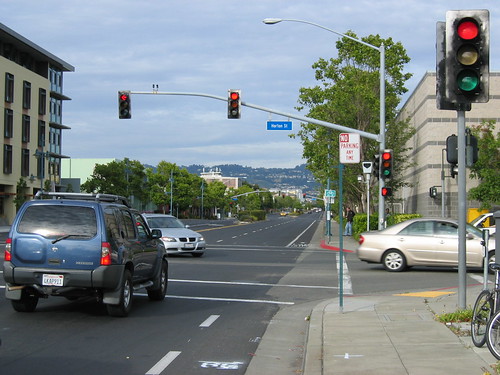
Recent news about red light cameras, like the cities of Loma Linda in California, then Houston, Texas, and now the city of Los Angeles doing away with them, have been disturbing for those concerned with road safety, and encouraging for those who believe red light camera tickets have become an aggressive tactic by municipal government to squeeze money out of motorists. The cities did away with the automated ticketing systems, despite evidence that the cameras prevent the most horrific and fatal type of accidents, the ones where a driver barrels through an intersection on a red light and gets into a side-impact collision. I appreciate the technology of an automated system to record by video and photograph the people who violate traffic laws, and I even believe the technology can be used to bring safety to people on the road. The implementation so far, however, leaves a lot to be desired.
On Monday, December 13, 2010, during the 2pm hour, Gil Gross, news-talk host on KGO radio, interviewed Los Angeles City Controller Wendy Greuel on her 77 page critique of the red light camera program. She made the point that 2/3 of red light camera tickets are for rolling right-on-reds, i.e., turning right on a red without coming to a complete stop. Wendy came to the conclusion that red light cameras cost Los Angeles more than the city collects in fines; the state of California taking a portion of these fines is one reason, but another reason is people are not paying the fines, and getting away with this because they can still renew their licenses with the DMV. In a damning rebuke of municipal greed, Wendy found that where the city puts these cameras are not where the most dangerous intersections are, but where they are easiest to install, i.e., where the city didn't have to work through a state process for an intersection near a state highway, or where there was the same kind of physical infrastructure at an intersection that the equipment installers had worked with before, and could easily work with again.
I was convicted of a red light camera traffic ticket on Tuesday, July 12, 2011, even though at trial I felt I presented a strong case with convincing arguments. As I mentioned in a previous blog post, how to file a stay of judgment, my read of the judge was he just didn't want to hear what I had to say. Fair enough, judges can do whatever they want in their courtroom, and he certainly wouldn't be the first person to reject whatever may be contradictory to what he wants to believe! The great thing about the criminal justice system (yes, a traffic ticket means you are being charged with a crime) is you can appeal your conviction when you've been found guilty of an infraction, which most traffic tickets are. If you don't want to pay the ticket, you either have to hire a lawyer, or invest a lot of time learning how to do this on your own. The first step to an appeal is filing a proposed notice of appeal, but before you can do so, you must do a lot of research, reading, writing, and preparation, using resources like highwayrobbery.net and Fight Your Ticket & Win in California. In California, you need to download from the internet or ask the court clerk for the CR-141-INFO packet, which gives you information on appeal procedures for infractions.
One of the main pillars of my defense at trial was the rule of "best evidence", which means in court the government has to submit their sharpest photos and video as evidence, and not some fuzzy copies. Under California Evidence Code 1520, otherwise known as the Secondary Evidence Rule, if submitting a document, the government has to provide an uncondensed version, not a summary or memo. On the website, at photonotice.com, where you can view your alleged violation, there is a disclaimer (which as of 5pm today, I've confirmed is still there) which states: "Due to formatting constraints this video is a representation of the original evidence and is not intended for court purposes...The video you are viewing on this website is provided as a courtesy and convenience to you. The video is in no way purported to be a true and correct copy of evidence that will be presented in court."
Because I asked the government numerous times to give me their best evidence, which are the high-resolution photos and video captured by the Redflex cameras, and said evidence was never provided to me, then for the purposes of trial, the rule of best evidence was never satisfied. At trial, the police service technician may have, on her laptop, access to the evidence you requested, and she may offer to show it to you, but since you asked for the evidence before trial, so you could prepare for your defense, and that evidence was never given to you, you can ask the judge to throw out the high-resolution copy that the police have and plan to use against you. If the judge throws out the high-resolution copy (which, in my case, did not happen), the police have no evidence against you, unless they decide to submit a lower resolution copy, or the officer might refer to the low res copy given to you in discovery. However, you can object to the admission of the low res copy under the rule of "best evidence".
The second step in an appeal is to file an opening brief, which the district attorney can respond to by filing a respondent's brief (this is unlikely in an infraction case). Filing an opening brief is mandatory, and after all the briefs have been filed, or the time to to serve and file them has passed, the court will schedule a date for oral argument. Below is what I submitted as my opening brief:
Recent news about red light cameras, like the cities of Loma Linda in California, then Houston, Texas, and now the city of Los Angeles doing away with them, have been disturbing for those concerned with road safety, and encouraging for those who believe red light camera tickets have become an aggressive tactic by municipal government to squeeze money out of motorists. The cities did away with the automated ticketing systems, despite evidence that the cameras prevent the most horrific and fatal type of accidents, the ones where a driver barrels through an intersection on a red light and gets into a side-impact collision. I appreciate the technology of an automated system to record by video and photograph the people who violate traffic laws, and I even believe the technology can be used to bring safety to people on the road. The implementation so far, however, leaves a lot to be desired.
On Monday, December 13, 2010, during the 2pm hour, Gil Gross, news-talk host on KGO radio, interviewed Los Angeles City Controller Wendy Greuel on her 77 page critique of the red light camera program. She made the point that 2/3 of red light camera tickets are for rolling right-on-reds, i.e., turning right on a red without coming to a complete stop. Wendy came to the conclusion that red light cameras cost Los Angeles more than the city collects in fines; the state of California taking a portion of these fines is one reason, but another reason is people are not paying the fines, and getting away with this because they can still renew their licenses with the DMV. In a damning rebuke of municipal greed, Wendy found that where the city puts these cameras are not where the most dangerous intersections are, but where they are easiest to install, i.e., where the city didn't have to work through a state process for an intersection near a state highway, or where there was the same kind of physical infrastructure at an intersection that the equipment installers had worked with before, and could easily work with again.
I was convicted of a red light camera traffic ticket on Tuesday, July 12, 2011, even though at trial I felt I presented a strong case with convincing arguments. As I mentioned in a previous blog post, how to file a stay of judgment, my read of the judge was he just didn't want to hear what I had to say. Fair enough, judges can do whatever they want in their courtroom, and he certainly wouldn't be the first person to reject whatever may be contradictory to what he wants to believe! The great thing about the criminal justice system (yes, a traffic ticket means you are being charged with a crime) is you can appeal your conviction when you've been found guilty of an infraction, which most traffic tickets are. If you don't want to pay the ticket, you either have to hire a lawyer, or invest a lot of time learning how to do this on your own. The first step to an appeal is filing a proposed notice of appeal, but before you can do so, you must do a lot of research, reading, writing, and preparation, using resources like highwayrobbery.net and Fight Your Ticket & Win in California. In California, you need to download from the internet or ask the court clerk for the CR-141-INFO packet, which gives you information on appeal procedures for infractions.
One of the main pillars of my defense at trial was the rule of "best evidence", which means in court the government has to submit their sharpest photos and video as evidence, and not some fuzzy copies. Under California Evidence Code 1520, otherwise known as the Secondary Evidence Rule, if submitting a document, the government has to provide an uncondensed version, not a summary or memo. On the website, at photonotice.com, where you can view your alleged violation, there is a disclaimer (which as of 5pm today, I've confirmed is still there) which states: "Due to formatting constraints this video is a representation of the original evidence and is not intended for court purposes...The video you are viewing on this website is provided as a courtesy and convenience to you. The video is in no way purported to be a true and correct copy of evidence that will be presented in court."
Because I asked the government numerous times to give me their best evidence, which are the high-resolution photos and video captured by the Redflex cameras, and said evidence was never provided to me, then for the purposes of trial, the rule of best evidence was never satisfied. At trial, the police service technician may have, on her laptop, access to the evidence you requested, and she may offer to show it to you, but since you asked for the evidence before trial, so you could prepare for your defense, and that evidence was never given to you, you can ask the judge to throw out the high-resolution copy that the police have and plan to use against you. If the judge throws out the high-resolution copy (which, in my case, did not happen), the police have no evidence against you, unless they decide to submit a lower resolution copy, or the officer might refer to the low res copy given to you in discovery. However, you can object to the admission of the low res copy under the rule of "best evidence".
The second step in an appeal is to file an opening brief, which the district attorney can respond to by filing a respondent's brief (this is unlikely in an infraction case). Filing an opening brief is mandatory, and after all the briefs have been filed, or the time to to serve and file them has passed, the court will schedule a date for oral argument. Below is what I submitted as my opening brief:
Red light cameras depend heavily on legal faith in a certificate that claims to confirm the total reliability of a machine's calibration and accuracy in detection, tracking, and overall synchronicity with the system of lights and cameras. Despite the possible hassle involved in confirming each fact at trial, it is essential to the integrity of the court system that questioning of the evidence be allowed. On the basis of my right to challenge the human elements of the evidentiary chain, I submit this appeal.Update: After a year and a half battle, I won my case on appeal in Superior Court, as detailed in this latest blog entry: Fight your red light ticket, and win!
Commissioner Culver's trial court ruling was not supported by substantial evidence because there was no live testimony by any person actually involved in the preparation or production of the crucial evidence. I have a right to confront witnesses under the 6th Amendment, as affirmed by the Supreme Court in Melendez-Diaz versus Massachusetts. In addition, the website where representations of the evidence can be reviewed, photonotice.com, states the following (copied verbatim, and current as of October 12, 2011): "Due to formatting constraints this video is a representation of the original evidence and is not intended for court purposes." I made multiple requests to the police and the city for the best evidence, i.e., the high resolution photos and video recorded by the Redflex cameras, by serving Dominique Burton, the agent of process for the city of Emeryville, by asking Rebecca Sylvester, Emeryville police technician, in person at the police station for said evidence, and by asking Sergeant Mike Allen, Ms. Sylvester's superior, in emails. When my requests were not fulfilled, I twice asked Judge Culver during arraignment to schedule a motion hearing to hear my motion to compel discovery, and during the second time I requested a motion hearing, I submitted a printed copy of said motion to the court that asked the city of Emeryville to either provide me with the best evidence, or else preclude the evidence that would be used against me during trial. None of my requests were fulfilled. The evidence used against me in trial should have been precluded, because the city of Emeryville did not comply with my discovery request.
Commissioner Culver made the following errors:
- refused or ignored my numerous requests for a motion hearing to compel the city of Emeryville to provide me with the best evidence.
- did not preclude the evidence when I asked him to, under California Evidence Code 1520
- called up a witness, Sarah Rutherford, co-custodian of records for Redflex, when I as the defense was never notified in advance (according to rules of discovery) that she was going to testify.
- did not want to see or consider the 2 rulings of the higher court in Alameda County, copies of which I brought with me and which I attempted to show Commissioner Culver. Both of these appeals cases, People v Singh (January 2010) and People v Blankenship (May 2010), overturned similar trial court rulings resulting in convictions for said defendants in red light camera photo trials. In both of these cases, the appellate court reversed the lower court ruling due to violation of the defendant's right to confront witnesses under the 6th Amendment.
- denied my motion to dismiss based on violation of my right to due process under the 5th Amendment, i.e., no motion hearing was scheduled for me when I requested it.
Thursday, October 27, 2011
How to Use Google Prediction API to Estimate a Sale Price for Your Home
This blog post is based on Martin Omander's workshop at Silicon Valley Code Camp, which I attended on Saturday, October 8:
If you've ever wanted to buy a house or sell your home, and would like a reasonable estimate for what the ultimate sale price will be in this market, you can get a real estate agent's take, or you can use Google Prediction API (henceforth Prediction) to give you another estimated price, given available market data. The idea is, you grab a number of sale price records for the ZIP code you want to buy or sell in, feed the data into Prediction, and Prediction will spit out a number based on the data you fed it. Besides spitting out scalar values, Prediction also does classification. To get your feet wet, here is a beginner tutorial that figures out, in an automated way, whether some text you pass in is English, French or Spanish:
http://code.google.com/apis/predict/docs/hello_world.html
Assuming you were able to successfully use Google's Prediction API, in conjunction with Google Storage and Google's APIs Explorer Tool, to classify samples of text that you pass in, the next step is to predict a sale price for your home.
Store your data, predict the futureThe real estate home price data file mentioned below was compiled by Martin from Redfin data for the Rex Manor neighborhood of Mountain View, California.
Speaker: Martin Omander
Level: Intermediate | Room: 3525 | 9:45 AM Saturday
- Make your smart applications smarter with Google's Prediction API. Take advantage of Google's machine learning algorithms to make recommendations, analyze Twitter, detect spam, classify documents, identify languages and more.
- Store your applications' data securely and efficiently in Google's data centers with the Storage API.
If you've ever wanted to buy a house or sell your home, and would like a reasonable estimate for what the ultimate sale price will be in this market, you can get a real estate agent's take, or you can use Google Prediction API (henceforth Prediction) to give you another estimated price, given available market data. The idea is, you grab a number of sale price records for the ZIP code you want to buy or sell in, feed the data into Prediction, and Prediction will spit out a number based on the data you fed it. Besides spitting out scalar values, Prediction also does classification. To get your feet wet, here is a beginner tutorial that figures out, in an automated way, whether some text you pass in is English, French or Spanish:
http://code.google.com/apis/predict/docs/hello_world.html
Assuming you were able to successfully use Google's Prediction API, in conjunction with Google Storage and Google's APIs Explorer Tool, to classify samples of text that you pass in, the next step is to predict a sale price for your home.
- Download Martin's houses.csv data here
- Using the same steps in the tutorial above, upload the houses.csv data into Google Storage, and then use the data to train Prediction
- After training is complete, we want to get a predicted price. To do this, we want to pass in the values for a house that we want to buy or sell. Let's say we're trying to sell a 3 bedroom, 3 bathroom, 1800 square foot, built in 1960, single family residence. I found that when I tried to pass in the following as a value for the csvInstance key, I got an error:
3 3 1800 1960 house
I then tried the same thing with commas, but that didn't work either. What I found finally worked is, in the APIs Explorer tool, when specifying the value of the csvInstance, you need to count how many field values you are putting in, let's call it n (in this case, n equals 5), then provision that same number by clicking on "Add" n times, and manually insert the values in order, like so:{
"input": {
"csvInstance": [
"3",
"3",
"1800",
"1960",
"house"
]
}
}
Subscribe to:
Posts (Atom)
