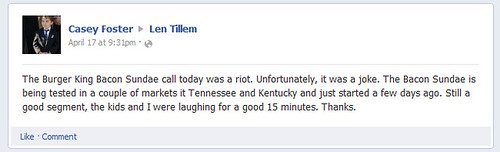
On April 17, a person identifying himself as Dave from Newark called the Len Tillem show, with a rather incredible story: he was in the employment of Burger King, promoting their new Bacon Sundae, when he was assaulted by a man. Dave then claimed he was subsequently fired by Burger King, and to add insult to injury, Dave was now being sued by the same man who assaulted him: About 2 months later, June 14, Burger King formally introduced its new Bacon Sundae, and news of the introduction reminded me of this call. I tried to find out more about this purported incident, and discovered an apparently real Facebook user, by the name of Casey Foster, commenting on Dave from Newark with a degree of certainty and authority, indicating that the call was fake: Now, Casey Foster's claim that the call was a joke could be false, and not necessarily because the man is a bad actor or acting maliciously; Casey's information could be incomplete or simply inaccurate, leading him to believe in a conclusion based on incorrect assumptions. Which brings us back full circle: is this story true? The jury is still out. Either scenario is plausible: someone who has a dietary restriction on pork for religious reasons might become very upset if this stricture of faith-based adherence has been violated, even unknowingly. People who like to play pranks sometimes successfully insert themselves into media events covered and broadcast by radio, television or newspaper, and the payoff is they become the topic of Internet chatter. Or the story could be fake, but the motivation may be more than the satisfaction of some joker, but that Dave from Newark could be part of a clever product placement or guerrilla marketing campaign, paid for by Burger King.
Whether the story comes from a credible witness or not, we have to be aware of the real possibility that a news story can be manufactured. A recent example of fake news making its way into the global consciousness came from the LA Times, published on May 10, 2012:
On May 1, The Times and a number of other media organizations followed the outrageous story reported in a British newspaper of a vengeful dentist in Poland who pulled out all of her ex-boyfriend’s teeth ... Unfortunately, MSNBC.com reported Wednesday, the story was a hoax.
MSNBC did some digging into the story and found:
Police in Wroclaw, Poland, had no record of such an incident.
Poland’s Chamber of Physicians and Dentists also had no record of any such incident, nor of the dentist named in the article.
The Daily Mail could not recall where the story came from.
And the American Dental Assn. said [that] such a case was highly improbable.
MSNBC (now NBC News) reports that the source of the news story, the Daily Mail, provided the following non-explanation for how an unverified story became world news:
The article, which has been shared on Facebook more than 75,000 times since it was published on April 27, appears under the byline of staff reporter Simon Tomlinson.
But Tomlinson said he does not know where the story came from and distanced himself from it when questioned about its origins. "I've drawn a bit of a blank," he said in an email. "The (Daily) Mail Foreign Service, which did the piece for the paper, is really just an umbrella term for copy put together from agencies. My news desk isn’t sure where exactly it came from."
As of Tor Browser version 4.02, I was able to upgrade to version 4.03 today (January 16, 2015) through an in-browser clickable notice, which also allowed me to restart Tor. Afterwards, all my bookmarks were automatically imported. However, below are the instructions in case you wanted to import bookmarks the way you did before.
So now that you can use Tor to bypass paywalls on websites that have metered content (though I encourage you to pay your fair share to media organizations like the LA Times that are doing a great deal of social good), we will discuss how, on Windows, you can retain, save, or migrate your bookmarks, when upgrading Tor on Windows. You can use Tor to browse the web anonymously, maintaining your privacy and keeping your online activity hidden from despotic governments and intrusive corporations. "I'm not doing anything wrong, so I have nothing to hide." True, although most of us would not welcome indoor cameras in our homes, because as your home is your castle, your own home computer should be your castle.
From participating in and reading online discussion, I've gathered that the method we're about to detail below cannot be applied to Tor installations on Mac and Linux operating systems. For now, the following process should work on Windows only.
Soon as you see "HOWEVER, this browser is out of date" (or in previous versions, "there is a security update available for the Tor Browser Bundle"), download the new package. Henceforth, the Tor installation that you plan to replace will be the old, and the Tor installation that contains the latest fixes and security updates will be the new.
In your old Tor folder, there is a folder containing your valuable bookmarks information. On Windows 7, if you're upgrading Tor version 3.6.6 to Tor version 4.0, the old Tor's places.sqlite file will be in:
Tor Browser\Data\Browser\profile.default
If you're upgrading Tor version 2.3.x (and earlier) to Tor version 3.5.x, the old Tor's places.sqlite will be in
Tor Browser\FirefoxPortable\Data\profile
Inside this folder, identify the file named places.sqlite and place it on your desktop by copying the file and pasting it onto your desktop.
Navigate to the location containing your old Tor folder, and move the entire folder containing your old Tor into a temporary location, such as your recycle bin. Do not permanently erase the old folder just yet, until you've confirmed that the new Tor works. You may want to keep the old Tor around in case the new Tor doesn't work correctly on your computer (more on this later).
Once you've moved the old Tor to a new location, download and uncompress the new Tor folder, and place it on your desktop
Inside the new Tor folder, click to run Start Tor Browser.exe
Once the new Vidalia is open, running, and has notified you that you are connected to Tor, wait for the new Tor browser to open up automatically. Once it has done so, immediately close and exit the browser and Tor.
In step 6, what we did was run for the first time a brand new instance of new Tor. New Tor created a new default bookmarks file. By exiting new Tor, we are now able to replace the new Tor's newly created default bookmarks file with your old Tor's bookmarks file. Navigate to the location where your new Tor's default bookmarks file is stored. New Tor's places.sqlite file will be in:
Tor Browser\Browser\TorBrowser\Data\Browser\profile.default
Once you are in your new Tor's "profile.default" folder (in Tor 2.3.x and earlier, you will be in the "profile" folder), confirm that there is a file called places.sqlite. You are going to replace the new Tor's places.sqlite with the old Tor's places.sqlite.
Locate the places.sqlite file that you had copied and previously set aside from your old Tor, which should be on your desktop. Copy the places.sqlite file from the old Tor into the "profile.default" folder. Confirm that you want to replace the new Tor file with the old Tor file.
Navigate away from the "profile.default" folder window, to the "Tor Browser" window, and click to run Start Tor Browser.exe. Wait for the new Tor browser to open up, and you should now see your old bookmarks.
As an aside, I have been confronted with how buggy Tor on Windows can be. To this day, I still haven't been able to figure out the root of a problem I encountered when upgrading Tor, but I have devised a workaround.
I'm currently running tor-browser-2.2.35-13, I attempted to upgrade to tor-browser-2.2.37, and was met with the following:
Vidalia was unable to start the configured web browser
Vidalia is the graphical controller and view of Tor's connections and settings. Startled and confused by this weird message, I get the sense that, for some unknown reason, tor-browser-2.2.37 just doesn't work for me. I decide to download and install the next level up, tor-browser-2.3.12-alpha-2. Everything seemed to be going ok, up to Vidalia starting and telling me I was connected to Tor. The next step was for the Tor browser to automatically pop open on my screen, but it never did. All that would happen was that Vidalia would run, but the Tor browser never appeared or opened up. I assumed this was because there was a bug with the alpha release, so I attempt to revert and go back to my last known working version of Tor Browser Bundle, 2.2.35-13. This time, when the Tor browser opens up, instead of the familiar message "Congratulations. Your browser is configured to use Tor.", I now have a new problem:
The proxy server is refusing connections
Firefox is configured to use a proxy server that is refusing connections.
Check the proxy settings to make sure that they are correct. Contact your network administrator to make sure the proxy server is working.
Whiskey. Tango. Foxtrot. Maybe I should go into Windows Registry and remove all traces of Tor. In regedit, I deleted all registry keys I could find after searching for
Tor Browser, tor-browser, tbb, tor, vidalia
Presumably, I had wiped the slate clean, and could reinstall Tor like I was installing Tor for the first time. I again tried the last known working version of Tor. Darn, no go! I got the exact same "proxy server is refusing connections" messages as before. I then decided to abandon Tor Browser Bundle, and try to install Tor on Firefox. In an act of desperation, I tried installing TorButton for Firefox, even though this is no longer in active development. This was to no avail, because I got the same messages; in fact, what I ultimately did with Firefox was erase my Firefox tabs and wipe out all the cookies I had accumulated. I then tried to install Tor on Google Chrome, and again got the same "proxy server is refusing connections" messages. To my utter shock, I had run out of ideas and had no working Tor browser on my computer, and had no clue even what the problem could be or where to go next. At a definite low point, frustrated, preoccupied, I kept fiddling around, until I hit on a bit of luck. Recall that I had three different "Tor Browser" folders from the installation packages for 2.2.35-13, 2.2.37-1, and 2.3.12-alpha-2. Keeping them all straight was a hassle, so I simply relabeled my last known working version as "Tor Browser, last known working, now broken". This was 2.2.35-13. Out of habit, I clicked on Start Tor Browser.exe, and lo and behold, Tor was working again! As an experiment, I went to the "Tor Browser" folder for 2.2.37-1, and simply changed the name of that folder, from "Tor Browser", to "Tor Browser_a". That worked too!
In conclusion, your inability to connect to Tor, signified by the "proxy server is refusing connections" messages, can be overcome if you simply rename your "Tor Browser" folder to another name other than "Tor Browser". For me, I renamed it simply "Tor Browser 2.2.37-1" and now I've got working Tor with all the latest security updates.
So what is the root of the problem? Given that I had gone into my Windows registry, and tried to remove all traces of Tor, I am at a loss. Frankly, I don't have the patience or the motivation to delve into and figure out the problem. My best guess is that something happened with Tor, Windows, or the interplay between the two, that has Windows associating the folder C:\Program Files (x86)\Tor Browser\ with a defective version of the Tor protocol. Even going into Windows registry and trying to remove all traces of Tor seems to be of no effect.
Once I got Tor working again, and figured out the workaround, was the moment where the Pope gets off the airplane and bends down to kiss the ground.
Update: Since filing an official bug report, I have been in contact with a Tor developer, who told me that the problem of seeing the message "Vidalia was unable to start the configured web browser" can be avoided if you make it part of your routine to store your Tor folder on your desktop, instead of in C:\Program Files (x86):
Only installed applications go in C:\Program Files (x86). The Tor Browser Bundle is self-contained and does not actually install itself onto your computer, it just runs whenever you click the Start Tor Browser.exe icon. If you run Tor from the Desktop, then you should not have any problems with Vidalia not being able to start the browser - now or when you upgrade.
A typical day in the life of a student of life involves trying to gather information about whether what a person says about himself, and our own ideas about that person, are accurate. One simplistic example involves getting a sense of a person's experience and background in the hard sciences by presenting the following word to him or her, without alerting the person that they are being put on the spot:
unionized
Most people might see the word union-ized, but a high school or college student who has spent some time with the periodic table, or someone in a laboratory, working with protons and electrons, would know about the tendency for some atomic elements to gain or lose electrons to other atomic elements, according to an atom's orbital shell; they might see the word as un-ion-ized. A person who works with her hands, or perhaps a labor law paralegal, who has experience in workplace discrimination or worker injury cases, or who served as a mediator in employment contract negotiation, may see union-ized. If a person says he is a chemist, and, in an unguarded moment, immediately sees and pronounces the word as union-ized, then you may be dealing with somebody who may be less than what he says. If a person says he is a community organizer, and pronounces the word as un-ion-ized, you may be dealing with someone who may be more than what he says.
Students of life that we are, you should already know much about studying for and taking tests and quizzes against a clock deadline, with observers making sure you have no unfair advantage, and the numerous assignments, problem sets, term papers, group projects, oral reports and other homework required of you at educational institutions, for which you then receive a score, grade or mark for your efforts. The American education system administers standardized PSAT and SAT or ACT tests in reading, writing, and math for students on the college track, which give you an idea of how well you performed answering verbal and quantitative questions in a controlled setting, in comparison with your peers. The people who paid for the test systems to be created and administered get an idea of what you know and whether you know how to use what you know to solve problems.
Whether you like it or not, you need to make space in your life for tests, either testing other people or being tested yourself, so that you're always subjecting your assumptions to scrutiny, making sure that the model of the world you have in your head corresponds to reality. In this way, you help decrease the probability of encountering unpleasant surprises in your daily work that could affect your life in a profoundly negative way. In 2002, Kent Beck introduced his book Test Driven Development, suggesting that the proper way to write computer programs was to begin not by writing code, but by writing a test for what you expect the code to do. Let's say you wanted to write a computer program that helped you pick lottery numbers, let's say for a large Mega Millions jackpot. Here are some expectations you demand must be met, or your code is no good:
There should be a total of six numbers
The first five numbers should include or be between 1 to 75 (formerly 1 to 56)
The sixth number should include or be between 1 to 15 (formerly 1 to 46)
Out of the group of five numbers, none of the numbers should be the same as another in the group
If your computer program code has failed any of the tests, then the code must be changed until it can pass the test. If all the requirements are met, then your code is passing all the tests, and you can move on to writing the next test, which might involve figuring out which sets of numbers are winners, or picking numbers for a different lottery game, perhaps the Fantasy 5, or Daily 3, and so forth.
In essence, writing a test involves first setting a minimum standard for your code that must be met, then writing your code and seeing it pass or fail. Writing the test first may seem silly (it certainly did to me for the longest time, and frankly, it sometimes still does), but the idea is that if you begin by writing code, you can spend hours and days optimizing and improving some piece that is not important; you should really be getting into the discipline of ensuring basic functionality is up and running (you can always make your code more terse, elegant and abstract when necessity demands). You want to prevent yourself from getting distracted from the main goal, which is to publish a basic, working prototype. Initially we wanted a way to generate numbers for a specific lottery game, but then we wanted numbers for different lottery games, and to figure out which number sets were wins. As your desires expand and grow, what was a simple computer program becomes more of an involved project, and quickly the program can become an application that is the foundation for a business or enterprise that might involve other programmers who want to look at and change your code. As your codebase grows, it becomes more complex and much harder to maintain, simply because what was once a simple computer program is now doing much more, and depends on more technology, written by other people, that is out of your control, and you may need to have people look over and touch your code. Writing tests first is based on the assumption that, in the long run, untested code requires much more time spent poring over and fixing puzzling bugs, than if you had done the hard work upfront. If your code is not supported by tests, you may have a greater probability of encountering a showstopper, i.e., some hard to find, unexpected problem in your system that prevents you from moving forward and releasing improved versions of your software in a timely manner.
One caveat: writing tests first is hard, perhaps more difficult than writing code first. There is the argument that if you start by writing tests, setting an expectation for what you want to see your code do, you can improve the design, and readily determine what are the essential pieces, and how you want to organize your code so that you can get a better idea when something goes wrong.
In closing, a recent PBS NEWSHOUR story really brought home to me the message of how important it is to create a system that is easy to maintain. A woman who has worked in Africa understands the problem of women dying in childbirth due to lack of light in maternity wards. Her husband, in response, designs a solar lighting apparatus that is portable:
Developing countries are a graveyard of well-intentioned technologies from the First World.
SPENCER MICHELS: Environmental engineer Ashok Gadgil has been consulting with WE CARE Solar. He developed the Darfur Stove that has revolutionized cooking in the developing world. And he's a senior scientist at the Lawrence Berkeley National Laboratory.
He says he's impressed with what he's seen so far, but he says if Stachel and Aronson are to succeed, they must address how the system will be maintained over the long term.
ASHOK GADGIL: No single technology, no single piece of machinery has infinite life. When one wants to introduce a technology into society, it needs social placement. The technology needs links and threads that connect it to a Web of experts or spare parts dealers or maintenance people or diagnostic technicians which will keep it going.
SPENCER MICHELS: How do you know that, after a year, this thing isn't going to get rusted or break or whatever?
Last Friday, my long battle against a red light camera ticket I received back in 2010 finally came to a positive conclusion. The ticket I received in the mail was a formal statement of the government's allegation that, on June 1, 2010, I made a rolling right on red, i.e., I didn't come to a complete stop before making a right turn in my vehicle. The problem is, no actual police officer was there to witness the incident, and the only purported evidence showing I had violated the law were photographs and video recorded by cameras operated by a for-profit corporation, Redflex Traffic Systems.
So, last Friday, when I showed up promptly for my 2pm hearing in Superior Court, and walked into the Department 1 courtroom, there was almost no one in the room, and you could have heard a pin drop. I saw two women in their 30s standing, huddled over a ledger, and I surmised they were courtroom staff. One of them asked me for my appellate court case number, and after she confirmed I was on the docket, I took a seat. Another male, about my same age, soon walked in, and apparently he was also there as a defendant for an appellate hearing. We four, the only ones in the court room, were soon joined by another woman, who also appeared to be courthouse staff, and who told me she would speak with the judge, as there was apparently a mix-up, as I was listed on the docket as not wanting to give an oral argument, even though I had expressly requested in writing that I wanted to speak at my hearing. This woman, who seemed to have the ear of the judges, left the room, then reappeared and confirmed that I would be on the docket for oral argument. Soon the appeals panel appeared, and we all stood for Justices Jon Tigar (presiding judge) and Gloria Rhynes. Normally, there are 3 judges on the panel, but one justice, Jacob Blea III, was absent that day. The entire proceeding lasted at most 15 minutes. Judge Tigar, who spoke on behalf of the appeals court panel, first called the other defendant's case, which I had overheard the women say was also a traffic matter, and Judge Tigar said that charges would be dismissed. He then called my name, and I walked up to the table and stood. Before I was able to utter a word of my prepared oral argument, the judge said that they had reviewed my case, and the charges against me would be dismissed, because hearsay was introduced as evidence. The judge asked me if that was alright, to which I replied, "Oh, very much alright, your honor." That was that, and I left right after.
Today, I received in the mail the following letter:
People of the State of California vs Thuon Chen
The judgment of the trial court is reversed 3-0. Similar to the affidavits held inadmissible in Melendez-Diaz v. Massachusetts (2009) 129 S.Ct. 2527, there was no live testimony by any person involved in the production of the Redflex Traffic Systems court Evidence Package (the "Redflex Packet"). Because the defense was not able to freely and adequately cross-examine the testifying witness on any of these issues, and because the absence of witness who could have testified as to the facts underlying the Redflex packet, Appellant's Sixth Amendment rights were violated, and the judgment of the trial court below must be reversed.
Remittitur to issue.
If you decide to fight your ticket, you will find that your experience in appeals court is a marked contrast to traffic court, which is much more crowded, especially at arraignment. Lots of people are there to tell their stories, when the judge (or more likely a commissioner, which Len Tillem likes to say is usually a lawyer who likes to wear a robe and hear people address him as "your honor") really only wants to hear how you plead. Your traffic court trial is where you can sit in on other people as they face the judge and the police officer. Most of the defendants at trial are not prepared and are hoping and betting on an officer not showing up to testify against them. The probability is high that a police officer will be present at your traffic court trial, because the police get paid to be there. What's funny (I'm sure it gets old for the presiding judge very quickly) is that when the police do show up, very often the defendant makes weak, anecdotal arguments, essentially pitting the defendant's testimony against the testimony of a sworn officer of the law. The judge is much more likely to believe what a police officer has to say. While doing research for my case, I got the sense that traffic court judges are like the hanging judges, that is, the police write the tickets and the judges collect. It's not until you, as the defendant, appeal your traffic case to Superior Court that you have a chance to make an argument before a receptive audience of jurists.
Here are the step by step instructions on how to fight your ticket and win. If a police officer actually saw you run a red light, you may be out of luck (unless s/he doesn't appear at your trial, which is unlikely). These steps apply to any traffic case where the only evidence used to charge you with a crime are recordings made by cameras operated by a for-profit corporation. Many municipalities, in addition to red light cameras, may also use traffic camera systems to collect evidence to charge people with exceeding the posted speed limit, or not coming to a complete stop at a stop sign:
Ask yourself if you have the wherewithal, the time, and the motivation, to make numerous appearances in court. If you don't want to pay the ticket, you either have to hire a lawyer, or invest a lot of time learning how to do this on your own. You will need to set aside hours to do research, collect your arguments, and put together the documents you need to jump through the hoops in traffic court. This means going to your arraignment, and asking the judge to schedule a motion hearing; in the event your arraignment judge does schedule a motion hearing, you will need to attend that hearing, with a copy of your motion in your hand, as well as a prepared oral argument; and of course, you will need to attend and argue at your trial.
Given that many towns, cities and states are in poor financial shape, the arraignment judge is not likely to honor your request and schedule a motion hearing. But if s/he does, you want to request that the municipality where you are alleged to have violated the law give you the best representation of the evidence that will be used against you, which are the full resolution photos and video. In a previous blog post, I detail my exploits in traffic court, how I asked the traffic court commissioner numerous times, in a total of three arraignment appearances, to schedule a motion hearing for me, to no avail; how the commissioner got so exasperated with my asking for a motion hearing at arraignment that he demanded I enter a plea, to which I replied "not guilty", and so the matter was set for trial.
If you attend all of your scheduled appearances at arraignment, the judge may release you on your own recognizance, i.e., not require you to pay bail in the amount of the fine. To my surprise, at my traffic court trial, Redflex Traffic Systems even sent their co-custodian of records, Sarah Rutherford, as a witness to testify against me. However, you are allowed to cross-examine even surprise witnesses, and her answers, or lack of answers, to your prepared questions can be used in your appeal. These are the questions I asked of the two people who testified against me during my trial (The first witness was the police service technician, and the last two questions were directed by me only to the Redflex co-custodian of records, in an effort to show that she is not an agent of the government, and because she is an employee of a for-profit corporation, her testimony in your trial does not hold the same weight as the testimony of a police officer):
How many technicians at Redflex were assigned to process Emeryville cases?
Who were the technicians who created the system for Emeryville, and who installed it?
Who were the technicians who reviewed this particular violation?
With regard to my case, was the photographic and video evidence recorded by Redflex originally in digital or analog form?
If the evidence was recorded digitally, what are the typical sizes of the photos and video please, in bytes and in resolution?
Have you had any federal, state or local police training?
What is the physical location of the computers that store the high resolution photos and video that are being used as evidence against me in my trial?
After you are found guilty, the judge will order you to pay your fine. In a previous blog post, I instruct you on how to ask for a stay of judgment after you've been found guilty, so that, while you appeal your conviction, you don't have to pay the fine.
You will have to develop a thick skin, because the judge who was present during your arraignment may be present at your trial, and may very well be dismissive of your arguments. S/he may even not-so-secretly hate you for wasting her time, when she has the photos and video showing someone, who looks a lot like you, appearing to violate the law.
Thanks to Jim, editor of highwayrobbery.net, for his correspondence and help, and for supplying me with actual digital copies of:
the motion to compel a municipality to either provide me with the best evidence, or else preclude the evidence that would be used against me during trial
Update: After you prevail in your lengthy court case fight, you may still notice an increase in your automobile insurance premiums when it's time to renew, based on the state DMV records your insurance company receives showing you were found guilty in traffic court because of traffic camera system evidence. This is despite the fact you fought long and hard to get the original traffic court conviction overturned on appeal. What your insurance company needs from you is proof from the DMV that the traffic court conviction was dismissed. This is a two step process:
Bring the proof your conviction was overturned in appeals court to your local traffic court clerk, and ask that this information be sent to the state DMV headquarters (in California, DMV headquarters is in Sacramento). My local traffic court clerk then went into the back, presumably spoke to someone or perhaps she herself had access to the court computer that talks to the DMV computer, and she came back and told me the dismissal had been sent to the DMV and my record had been cleared.
Your insurance company will want an updated copy of your driver record (some call it a "DMV abstract") faxed or mailed to them. In California, you can get a copy online for $2 by printing it out from your web browser at http://www.dmv.ca.gov/online/dr/welcome.htm Or, time permitting, you can schedule an in-person appointment to confirm with the DMV representative that the conviction has been removed, then ask to get a copy of your driver record as a DMV printout that comes with an official seal. This cost me $5.
A recent Associated Press story, reporting from Arizona, on the coming out of Pinal County Sheriff Paul Babeu at a news conference included an interesting phrase I had not heard before, coming from a supporter of the sheriff, who was trying to reconcile the sheriff's public statement of homosexuality with the supporter's own traditional conservative Republican hardline stance on God, guns, and, yes, gays:
Consider the comments of Bill Halpin, a 64-year-old ex-Air Force pilot who serves on the local tea party board: “I care less. I just care less. Don’t preach it on me. Don’t push it on me and, by golly, I respect your rights.”
I care less, full stop. An interesting standalone phrase, used to express a devil-may-care attitude, perhaps even a professed dismissive nonchalance, with the hint of a barbed defense, on the speaker's part. While this phrase was new to me, I have certainly heard of other phrases people use to express a similar sentiment: "I could care less", full stop. Or "I couldn't care less", period.
Is "I care less" related to the aforementioned two phrases? They all seem related, and it's even possible one came before the other before the other, rather than they all arose at about the same time; "I care less" could be a clipped or shortened form of "I could care less", which could be a clipped or shortened form of "I couldn't care less". Those who are into the origins of words or phrases know that the Oxford English Dictionary does the work of tracking down the first recorded instances of a word or phrase being investigated, but I have not performed the necessary etymological research to reach an informed conclusion. While it's possible that "I couldn't care less" came first, and after some time "I could care less" arose and became widely used, and now, we have "I care less", the focus of my piece will be on how "I couldn't care less" and "I could care less" are used to express the same sentiment. Upon first encounter, an audience of one would be right to reach the conclusion that a literal interpretation of the two gives one the sense that they seem to convey two entirely different, even polar opposite, meanings.
A common saying about the entertainment industry in Los Angeles, in Hollywood especially, is that no one ever says no: "In this town, they kill you with yes." The idea is, anyone you meet could become very popular, accomplished, esteemed, powerful, rich, and in an enviable position. On the road to success, particularly in movies, television and music, but also in the related creative fields of fashion, photography, design, culinary arts, writing, and performance, there are few, if any, rules, and many exceptions, to making it big; the person who you very pointedly say no to today, who you offend with your rejection, in whose face you shut your door, that person may become a star overnight, and tomorrow, is in a position to say no to you. So, because people are social animals, even if you mean "no", you always say "yes":
A similar thing may be happening in the brain with "I couldn't care less" and "I could care less". My immediate reaction to your proposal may be, I do not like your idea or even think it will work. Since the spirit of the times is, people don't ever want to burn bridges, I want to take the potentially dangerous step of rejecting something that you seem invested in, without seeming to do so. While "I couldn't care less" may be technically correct, and how I really feel, the problem is, it's too harsh. So instead, I say, "I could care less"; the idea being communicated is "I care, enough that it's quantifiable, and in fact, the amount of concern I have is distant from not caring at all", advancing the idea first that I, as the speaker, care, and once you see and hear the train of "yes" roar through, the engine is followed by the caboose, that, perhaps, the speaker might not care at all, or at least, not as much as you, as the listener, do.
It's certainly an idea, but I'll admit it's a little far-fetched. Usually, a person's face and body are contorted a certain way, or, in the heat of the moment, the shaking of the head, the look of defiance, the surrounding words, the unspoken information, all reveal and reinforce the speaker's true thoughts when exclaiming "I could care less" on a topic, so the idea that omitting the "n't" sound at the end of "could" is a believable way to spare a person's feelings seems a bit of a stretch. So here's another way to understand why people would rather say "I could care less" than "I couldn't care less". They really could care less! When it comes to using contradictory phrases to mean the same thing, I maintain that this practice is closely related to how people interchange "I couldn't give two bits", or "I could give two bits", or in the comfort of your home, among familiars, sometimes you may use coarser language to express your relative unconcern: "I couldn't give two [censored]", or "I could give a [censored]".
Thus, a final try to understand this phenomena of hearing someone say, "I could care less," or even "I care less", when he or she means "I couldn't care less" is, because the speaker is really saying what he or she means, but in shorthand, and, crucially, with the listener in mind. "I could care less" means "I could care less than how much you apparently think I should, but I won't even make an effort to, because I don't care at all." "I care less" means "I care less than you think I should care." Verbal shorthand is when, to save time, you substitute a shorter word or phrase for a much longer and unwieldy one, or, getting back to the first point, in order to save someone's feelings from getting hurt, verbal shorthand can be when you substitute a fuzzier, less clear word or phrase for an unambiguous one. Sometimes, this verbal shorthand uses a substitute that is the exact opposite of what you mean to say. So, in essence, the speaker seems to literally say "I care", but the message of "I don't care" is understood by the listener and the speaker.
By this time, our overly long discussion on language minutiae perhaps has you caring even less than you thought you could've possibly cared. I can tell by you glancing at your watch and tapping your foot that you couldn't, or could, care less. In that case, let us end with the immortal words of Green Day's American Idiot, "I don't care if you don't care."
Imagine you are going to a genteel scone and crumpets breakfast party in the English countryside. In another time and place, to be invited to such a gathering would have meant you had arrived, as they say, into the society pages. "Anything less would be uncivilized," you might utter, with your pinky finger sticking way out in the air, as you and your gentle friends titter over tea and biscuits and contemplate a jaunt to the opera. You are uninvited, but you still want to go, so you invite yourself to the gathering, knowing there are others like you in support of a planned assembly, a rally of sorts, even a demonstration of your numbers, and your attendance is part of a larger uprising and community movement. Before, during and after the event, you post and look at pictures and video, text, tweet, maybe facebook or google search, chat, email, all this in support of your common goal, to non-violently disrupt business-as-usual, and pleasure-as-usual, in the layers of society that seem to you unbearably hardened, even calcified. In preparation for the protest, you and your ever growing society hang out and chat in-person, then use your laptop and notebook computers, tablets, cellular phones, smart phones and PDAs, to form your own network of friends, to create a buzz and attract more people, and on the day of the event, you print out maps and directions, see what other people are doing and tag along, and before you know it, you've used the Internet and mobile phone network (collectively called the cloud) to plan, collaborate, share, publicize, attend, rally, demonstrate, and afterwards, document what happened, learn from others, and possibly prepare to organize and make the announcement to occupy another location.
About a year and a half ago, the author Clay Shirky gave a talk on cognitive surplus, "the shared, online work we do with our spare brain cycles. While we're busy editing Wikipedia, and making LOLcats," he argues, "we're building a better, more cooperative world." Clay states that people want to consume, but also we like to create, and sometimes we want to share. He relates the story of a woman in Kenya who found, in the midst of a disputed presidential election, that there was an outbreak of ethnic violence. In her blog, she solicited from her commenters more information about the dangers inherent in any succession of power in human society, and what areas to be mindful of, depending on who you were. She collated and posted the information flowing in, but there was so much data coming in, it became way more than one woman could manage. She asked if there was a way to automate the process. Two programmers saw her plea for help and, in 72 hours, launched ushahidi, which means witness or testimony in Swahili. This application very simply takes reports from the field, i.e., from the web, or mobile phones and sms, aggregates those reports, puts it on a map and makes it public. The app spawned a social push which became known as crisis mapping. Enough people found ushahidi valuable that the programmers decided to make it open source and turn it into a platform. The number of deployments of ushahidi went from a single idea and implementation in Kenya, to global reach, in less than 3 years. Cognitive surplus, then, can be the ability of the world population to volunteer, contribute, and collaborate on large, sometimes worldwide, projects.
In his talk (below), Clay Shirky states that civic value is when something is created by the participants, but enjoyed by society as a whole; when something is enjoyed just by the participants, that would have only communal value. When the Occupy Wall Street movement was getting started in New York, one of the first things the group did was put, at the top of their website, a link to the software platform that the participants used to consume, create and share. The idea was, should the movement catch fire (and how!), Occupy groups in other cities could download, install, deploy and begin their own geographic base of online operations. Github is where the occupy movement and ushahidi store their repositories, which contain the master copy of the project. Anyone in the world, on their own initiative, can download and install the software built from the master code, On a computer with a connection to the internet, you can soon host your own city chapter. You can contribute to the technological platform you downloaded by helping people get connected and stay more involved towards a common goal. For those who have spent enough time thinking about and using a tool, suggestions for improvement or features come to mind, such as adding the ability to show live video, or to display content in a specific language, or to give some users more or less responsibilities and privileges. If you make a change to your local copy, such as fixing a mistake, those improvements can be merged into the master code, and the communal becomes civic.
But that is all really big picture, so let's bring it back to the day to day life each one of us leads. How does this all apply to me? As we start in on 2012, what gets me out of bed in the morning is getting more users. I am here, and at your service. Last year, I had a goal of creating 2 blog posts for every month, which worked out well; now my new year's resolution is to make an app and host it on github, and to show you how to do it.
I'm a Taipei, Taiwan-born immigrant who received a BA in English Literature from UC Berkeley, and recently became an American citizen. I've been a computer programmer in California for the past several years and am currently pursuing graduate studies in Biostatistics. Recently, I was challenged intellectually when crafting a response to a woman whose son was shot at a sideshow in Oakland, CA.